
The operator's liability in the case of an incident is limited to 3,000 crore for reactors with thermal power above 3,600 Megawatt; 1,500 crore for reactors with thermal power between 1,500 Mw and 3,600 Mw; 750 crore for reactors with thermal power between 750 Mw and 1,500 Mw; 300 crore for reactors with thermal power between 150 Mw and 750 Mw; and 100 crore for reactors having thermal power up to 150 Mw, fuel cycle facilities other than spent fuel reprocessing plants and transportation of nuclear materials.

The Indian government has introduced a bill to overhaul the civil nuclear sector, allowing private participation and establishing a new liability regime. The SHANTI Bill, 2025, aims to repeal existing acts and address industry concerns.
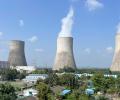
The Bill is likely to pave the way for amending two existing legislations -- the Atomic Energy Act 1962, and the Civil Liability for Nuclear Damage Act 2010.
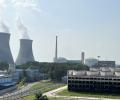
Government sources said amendments were being considered to the Atomic Energy Act to allow private sector participation and the Civil Liability for Nuclear Damage Act to limit the liability on suppliers of equipment to build atomic energy plants.
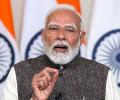
India on Saturday announced plans to amend its nuclear liability law and set up a nuclear energy mission, a move that came ahead of Prime Minister Narendra Modi's likely visit to the United States.

With the regulatory approval from the US Department of Energy in its kitty, Indian multinational conglomerate L&T is planning to focus on manufacturing small modular reactors (SMRs) to play a leading role in the commercialisation of nuclear energy in India.

The government has finalised the much-awaited rules of implementation of the nuclear liability law, a move that could pave way for the expansion of the atomic power sector by procuring equipment from foreign suppliers. "A PMO committee has approved the rules of implementation of the civil nuclear liability law. We will notify the rules within a month," V Narayanasamy said. The Civil Liability for Nuclear Damage law was passed by Parliament last year.
In the second part of a three-part series, Manoj Kumar and Lydia Powell, in an Observer Research Foundation study, discuss at length the various loopholes in the Nuclear Liability Bill, whose amended version was recently passed by the Lok Sabha.
Greenpeace has also launched a petition addressed to Prime Minister Manmohan Singh, which the organisation claims has been signed by over 21,000 people.
While the cap on liability is lower than in several other countries, few producers, including those in India, will supply nuclear power equipment without such a bill -- raising the caps is an obvious solution.
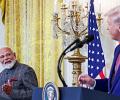
Prime Minister Narendra Modi and US President Donald Trump have vowed to move forward with plans to work together to build US-designed nuclear reactors in India. The decision was made during their meeting at the White House, where they also agreed to significantly expand energy cooperation. The move comes after India announced plans to amend its nuclear liability law and the Atomic Energy Act, which had previously been obstacles to the implementation of the US-India civil nuclear deal.

'If the BJP detoxifies the nuclear liability law, it will bring economic, environmental and, most of all, strategic benefits.' 'Let's keep our fingers crossed and hope that this Budget promise is met soon -- ideally, before Mr Modi heads to his first meeting with Trump 2.0,' observes Shekhar Gupta.
What is in store for the Koodankulam nuclear power plants, asks S P Udayakumar.
The Parliamentary Standing Committee on Science and Technology, which has held marathon deliberations on the controversial Civil Liability for Nuclear Damage Bill 2010, is expected to present its report to Parliament on August 9.
The passage of the Women's Reservation Bill in the Rajya Sabha on Tuesday has not ended the problems of the United Progressive Alliance (UPA).
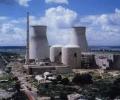
If a public sector company willfully enters into an agreement with a foreign vendor and abdicates its right to recourse which otherwise provides for its benefit, it would not only be violating the provisions of the Civil Liability for Nuclear Damages Act but also section 13(1)(d) of the Prevention of Corruption Act, notes Leader of Opposition in Rajya Sabha Arun Jaitley

The opposition has been demanding a debate on Operation Sindoor -- the strike on terror sites in Pakistan by the Indian armed forces in response to the terrorist attack in Pahalgam on April 22.

Indian and American experts on Wednesday held detailed discussions on a range of implementation issues, including administrative, liability, technical and licensing matters to advance the operationalisation of Indo-US civil nuclear cooperation that has been in limbo for past 9 years.
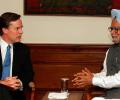
The India-US nuclear deal was aimed at ending India's nuclear isolation and nuclear apartheid, recalls Rup Narayan Das.
India Inc on Tuesday expressed deep reservations over the supplier liability provision -- the contentious Clause 17(b) -- in the Civil Liability for Nuclear Damages Bill, 2010, saying it would seriously hinder nuclear commerce.
Ushering in reforms, Union Finance Minister Nirmala Sitharaman on Saturday proposed to open up the nuclear power sector for private players and announced a Rs 20,000 crore Nuclear Energy Mission for research in the field, with an aim to set up five small and modular reactors by 2033.
Ending months of wrangling between treasury benches and the opposition, the Lok Sabha on Wednesday passed the civil nuclear liability bill after government dropped the contentious provision of 'intent' in the case of accident adopting a Bharatiya Janata Party amendment, paving the way for nuclear commerce with the world.
Paving the way for India to have nuclear commerce with the world, Parliament on Monday adopted a nuclear liability bill with the government insisting that the compensation package for victims matches that of the United States and it was still open to accommodate some suggestions.
The Bharatiya Janata Party and the Left parties have already indicated opposition to the Civil Liability for Nuclear Damage Bill that is key to operationalise the landmark Indo-US nuclear deal. The Bill pegs the maximum amount of liability in case of each nuclear accident at Rs 300 crore to be paid by the operator of the nuclear plant.
Chairman of Parliamentary Standing Committee on Science and Technology T Subbirami Reddy on Friday voiced confidence that the report on the nuclear liability bill will be tabled in Parliament on Wednesday, despite differences among members.
The passing of the nuclear liability bill will be a political and diplomatic victory for Prime Minister Manmohan Singh at a time when he is being seen as getting weaker and his government is drifting on all major national challenges like price rise, Kashmir and Naxalism.
Gopal Krishna makes a case against the nuclear liability bill.
Getting the requisite numbers to pass the Civil Liability for Nuclear Damage Bill 2010 in the Lok Sabha may be the least of the United Progressive Alliance's problems. Lawyers and legal experts, including those who support the legislation, say there are many instances of poor drafting and anomalies that have the potential to generate more controversy if the Bill is passed in its current form.
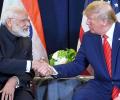
It would be the prime minister's first bilateral visit to the US after Trump became president for a second term.
The Supreme Court on Friday sought the government's reply to a plea challenging various provisions of the controversial Civil Liability on Nuclear Damage Act.

US urges New Delhi to align its nuclear liability law with the international convention
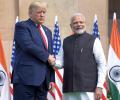
Prime Minister Narendra Modi will pay a two-day working visit to the US from February 12 during which he will meet President Donald Trump, the external affairs ministry announced. The visit will give further impetus and direction to India-US bilateral relationship. Prior to his US visit, Modi will be in France from February 10-12 to co-chair the AI Action Summit with French President Emmanuel Macron. He will also visit Cadarache, the site of the International Thermonuclear Experimental Reactor of which India is a partner. During his visit to France from February 10-12, Modi and Macron will also address the India-France CEOs forum. The prime minister and Macron will travel to Marseille where they will inaugurate the Consulate General of India. The leaders will also visit the war cemetery and pay tribute to the sacrifices made by Indian soldiers in World War 1. Modi and Macron will visit Cadarache, the site of the International Thermonuclear Experimental Reactor (ITER). There has been a very close rapport between Trump and Modi, dating back to the US leader's first term. There is a clear convergence of interests between the two countries in several areas, including trade, investment, technology, defense cooperation, counterterrorism, Indo-Pacific security, and people-to-people relations.

The Indian Nuclear Energy Pool, meant to insure risks from nuclear reactors, may take longer to be set up. While the idea of forming a pool was mooted earlier this year, it has reached a deadlock owing to differences among the stakeholders on certain clauses.

John Kerry, US Secretary of State, who is here for the 2nd Indo-US Strategic and Commercial Dialogue, said his country would want its civil nuclear cooperation with India to take shape in setting up of reactors.
Pitching for enactment of a law to fix civil damages caused by nuclear accidents, Atomic Energy Commission Chairman Srikumar Banerjee said neither the Indian Environmental Protection Public Liability Insurance Act, 1991, nor the Indian Atomic Energy Act had provisions for damages caused due to war or radioactivity.
Whether the ambitious targets are achievable is a moot question as India's earlier target was 20,000 MW of nuclear power by 2020.

Although the credit for acquiring the technological skill must be given to India's outstanding nuclear scientists, the decision to go nuclear was a political one that entailed clarity of vision, courage and resolve, points out Rup Narayan Das.

'The real story of 2025 is that India officially stopped being a 'market of the future' and started acting as the world's primary economic engine.'

Posing a series of questions to the prime minister, Congress general secretary in-charge communications Jairam Ramesh also asked if Modi would convey to the US president that India would send its own aircraft -- like Venezuela and Colombia did -- to bring back Indian deportees in the future.
Facing stiff opposition over the Nuclear Liability Bill, the government on Friday said it will consult all political parties before tabling the draft legislation in Parliament. "
 © 2026 Rediff.com - Advertise with us - Disclaimer - Privacy Policy - Sitemap - Feedback - About us - Terms of use - Grievances